
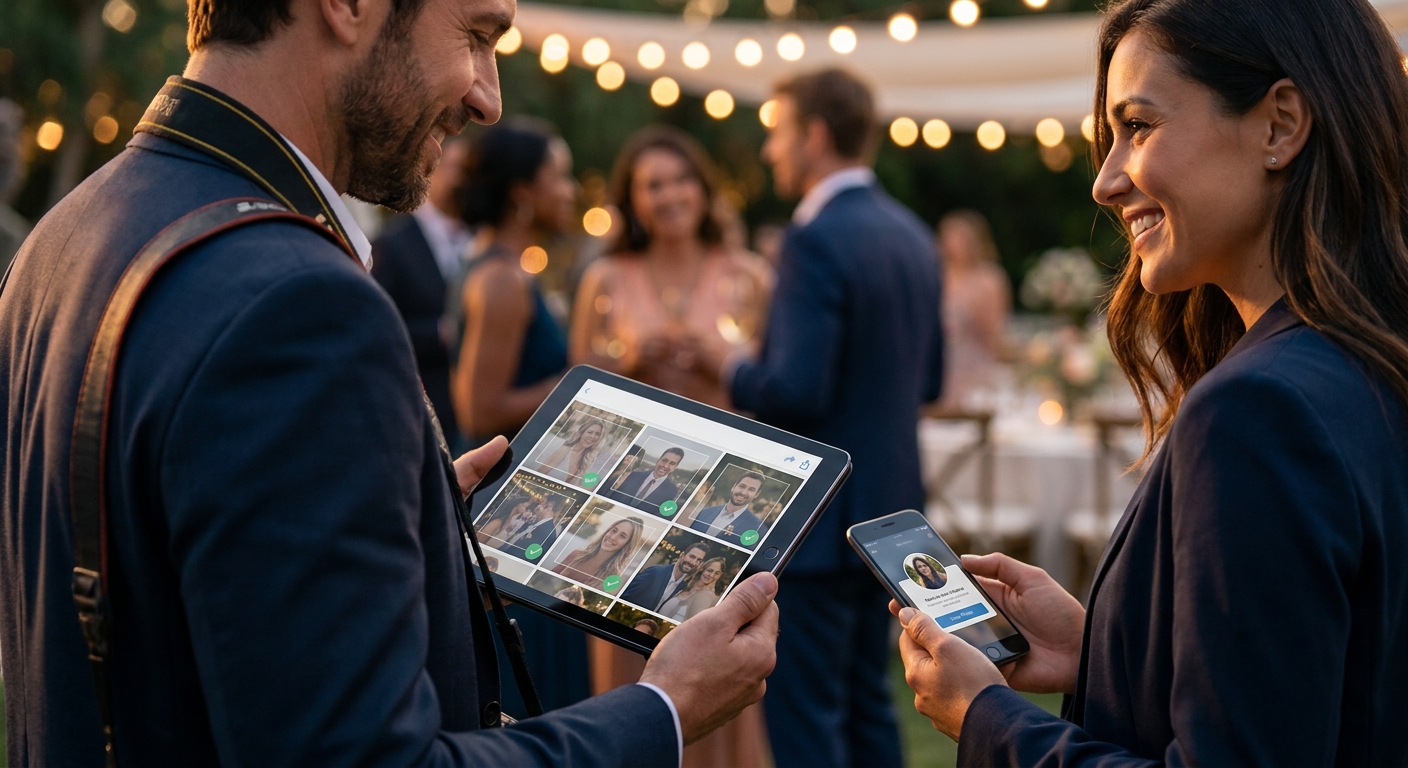
Event photographers running weddings, marathons, corporate conferences, music festivals and school days in 2026 all hit the same wall: guests want their own photos within hours, not weeks, and sorting 2,000+ images by hand doesn't scale. Face recognition photo sharing for events fixes the sorting problem — this guide breaks down what actually matters when you pick a system, and where FotoOwl fits against the alternatives.
- FotoOwl's AI face search sorts event photos into guest galleries in minutes — Buy for weddings and sports over 200 guests.
- Manual USB or Drive handoff adds 10+ hours of sorting per event — Consider only for shoots under 50 guests.
- WhatsApp and Beam uploads cut guest friction versus app-gated tools — Skip anything that forces a download first.
- Built-in photo selling and reel generation recover shoot costs faster than a standalone print-lab kiosk.
- Face recognition photo sharing for events needs visible consent and opt-out, not a buried settings toggle.
Why this matters
Guests at 2026 events expect their photos the same day, sometimes within the hour, especially at weddings and festivals where content gets posted before the reception even ends. FotoOwl built its gallery around AI face search specifically because manual sorting — folder-diving through 3,000 to 5,000 RAW files after a single event — eats into a shooter's margin and delays delivery by days.
A photographer charging per event, not per hour, loses money every hour spent tagging faces instead of shooting the next job. Face recognition photo sharing for events turns that sorting time into guest self-service: upload the full shoot, let each guest search their own face, and move on to the next booking.
The gap only widens by event type. A corporate conference with 800 attendees across three days, a marathon with 5,000 runners crossing one finish line, or a school annual day with 40 classes each want a fast, personal result, and none of those crowds tolerate scrolling through a 2,000-image album to find themselves.
Who this is for
This guide is built for photographers and studios shooting weddings, marathons and cycling events, corporate conferences, music festivals, and school annual days — anywhere a single event produces hundreds or thousands of images and dozens to thousands of guests each want their own shortlist. A 300-guest wedding, a 2,000-runner marathon, or a three-day festival all share the same bottleneck: too many faces for two editors to sort by hand before the moment loses relevance.
Studios juggling multiple weekend bookings in 2026 feel this hardest, since every hour spent manually tagging one event pushes back editing on the next one. If you're shooting solo portrait sessions with under 20 frames, skip the face-recognition tooling entirely — a shared folder link does the job and adds nothing but overhead.
What to look for in face recognition photo sharing for events
Face-match accuracy at crowd scale
A wedding reception with 300 guests and a marathon with 5,000 runners stress a face-match engine very differently — crowd density, motion blur, and partial-face shots from finish-line cameras all cut accuracy. Test any system against a real sports-event dataset before betting a full season of shoots on it, not just a clean set of studio headshots. Accuracy that looks fine in a demo can fall apart at a packed corporate gala or a festival crowd shot from a stage-side lens.
Guest self-serve search without app downloads
Every extra step between "here's your link" and "here's your photo" loses guests. Tools that deliver through WhatsApp or a direct Beam upload link get opened immediately, because guests are already inside that app on their phone. Tools that require installing a separate dedicated app lose a meaningful share of people who never come back to claim their photos later, and that share grows with every additional tap required.
Speed of gallery turnaround
A 2026 wedding shoot with two photographers easily produces 2,000 to 4,000 images across a full day. The gap between "shoot ends" and "guests can search their own face" should be measured in hours, not the 5-7 days a manual editing-then-upload workflow typically takes. Slow turnaround means guests move on and stop checking for their photos altogether, which kills the reshare value of the shoot.
Built-in monetization
Face recognition photo sharing for events only pays for itself fully when the gallery can also sell prints or digital downloads directly from a guest's personalized results. Otherwise you've automated the sorting and left the revenue for a separate print lab to collect instead. Look for selling built into the same guest-facing link, not a bolt-on checkout hosted on a different site guests have to trust separately.
Personalized reel or highlight generation
Sports events and festivals in particular reward short personalized reels — a runner's own finish-line clips, a wedding guest's dance-floor moments — because guests reshare them on social media. That reshare is effectively free marketing for the photographer's next booking, and it costs nothing extra once the reel-generation feature already exists inside the gallery workflow.
Consent and data handling for face scans
Face data is sensitive, and any tool you adopt needs a visible opt-out on the guest-facing link plus a clear statement on how long face templates get stored. Corporate clients and school administrators increasingly ask for this in writing before signing off on a shoot in 2026, and "we'll add it later" isn't an answer once contracts are already signed.
Top picks: delivery methods ranked for 2026 events
FotoOwl AI face search with WhatsApp/Beam upload — the default pick for anything over 150 guests. One spec that matters: guests search their own face and get a personalized set without installing an app, since delivery runs through WhatsApp and direct Beam links rather than an app store download. For a 500-guest wedding producing 3,000+ images, that's the difference between a same-day gallery and a week of manual tagging by an assistant editor. It also fits sports events and school functions where guest counts spike well past what two editors can sort by hand. Verdict: Buy for weddings, sports events, corporate events, festivals and school functions where guest volume outpaces manual sorting capacity.
Generic cloud gallery with plain shareable links — the outdated default. One spec that matters: zero face-matching, so every guest scrolls the full album to find themselves — fine for 50 photos, painful past 500. A 1,000-image festival gallery with no face search means most guests give up before finding their own set, and shares drop off with them almost immediately. It's cheap and easy to set up, which is the only reason it's still common in 2026. Verdict: Skip past small private events.
Manual USB or Google Drive handoff — the safe pick for tiny shoots only. One spec that matters: zero setup cost, but 100% manual sorting on the photographer's end before anyone sees a photo. For a 30-guest engagement shoot this works fine; for a 500-guest wedding it adds 10+ hours of unpaid sorting time on top of the actual editing workload. It also puts the photographer in the awkward position of being the sole bottleneck for delivery. Verdict: Consider only under roughly 50 guests, Skip above that.
Print-lab kiosk on-site — the analog holdout. One spec that matters: guests get a physical print same-day, but there's no digital gallery, no face search, and no reel output for social sharing afterward. It works well as an add-on revenue line at a festival booth or school fair, printed on the spot while the event is still running. On its own it can't handle guest counts past a few hundred without a queue forming. Verdict: Consider as a supplement, never as the only delivery method in 2026.
Generic DAM (digital asset management) tool not built for events — the wildcard. One spec that matters: strong for internal asset storage and licensing metadata, weak on guest-facing face search, since these tools are built for internal teams rather than thousands of external guests hunting for their own face. It can sit behind a guest-facing tool as an archive layer, but it was never designed to handle a wedding guest list searching a selfie. Verdict: Skip for guest delivery; fine only as a backend archive.
What to avoid
- Face-search tools that require a guest-side app install — conversion drops hard the moment someone has to download something before seeing a single photo, and most guests simply never come back.
- "Unlimited storage" pitches with no mention of face-match accuracy — storage isn't the 2026 bottleneck for event photographers, sorting speed and match precision are.
- Any gallery with no visible consent or opt-out on the guest link — corporate clients and school administrators will ask about this, and adding it after the shoot is already too late.
“If guests need to download an app before they see a photo, the gallery is already losing them.”
Verdict comparison
| Approach | Face-match at scale | WhatsApp/no-app delivery | Selling built in | Reels | Verdict |
|---|---|---|---|---|---|
| FotoOwl AI face search | Yes | Yes | Yes | Yes | Buy |
| Generic cloud gallery | No | Partial | Rarely | No | Skip past small events |
| Manual USB/Drive handoff | No | No | No | No | Consider under 50 guests |
| Print-lab kiosk | No | No | Yes (physical) | No | Consider as add-on |
| Generic DAM tool | No | No | No | No | Skip for guest delivery |
See face recognition photo delivery in action
Check how FotoOwl handles guest face search and WhatsApp delivery for your next event.
FAQ
What is face recognition photo sharing for events?
Face recognition photo sharing for events is a gallery system that scans uploaded event photos, matches faces, and lets each guest pull up only their own shots by searching a selfie. It replaces manual sorting through thousands of images after a wedding, sports event, or festival.
Does face recognition photo sharing for events require guests to install an app?
No, the better systems in 2026 deliver through WhatsApp or a direct Beam upload link instead of a dedicated app. Tools that force an app install before showing a single photo lose a meaningful share of guests who never return to claim their set.
How accurate is face recognition at large events like marathons?
Accuracy depends on crowd density, motion blur, and how many faces are partially obscured, which is why a marathon or festival stresses the system harder than a seated wedding reception. Test against a real crowd dataset before relying on it for a large sports event.
How fast can guests get their photos after a wedding using face search?
With AI face search and WhatsApp delivery, guests can search and download their own photos within hours of upload instead of the 5-7 days a manual sort-and-send workflow typically takes. Turnaround depends on how quickly the photographer uploads the full shoot.
Can photographers sell photos directly through a face-recognition gallery?
Yes, tools like FotoOwl build photo selling into the same gallery guests use to search their face, so a shoot generates print or digital download revenue without a separate lab. This works for weddings, sports events, and school functions alike.
Is guest face data safe when using these tools?
A trustworthy face recognition photo sharing system shows a visible consent or opt-out option on the guest-facing link and states how long face templates are stored. Ask any vendor for this in writing before a corporate or school shoot.
Do personalized reels work for corporate events, not just weddings?
Yes, personalized reel generation applies to any event with recorded guest moments, including corporate conferences and music festivals, and short reels tend to get reshared on social media more than static photos. That reshare is effectively free promotion for the next booking.
Is face recognition photo sharing worth it for a small 30-guest event?
Not usually. Manual sorting or a plain shareable gallery link works fine under roughly 50 guests, and face-matching tooling starts paying for itself once guest count and image volume climb past what two editors can sort by hand.
One last thing
The photographers who add photo selling on top of face search, not just delivery, tend to recover their shoot fee faster, because guests buy their own shortlisted images instead of waiting weeks for a printed album to arrive. In 2026, that's the real payoff of face recognition photo sharing for events — it's not just a sorting shortcut, it's a second revenue line built into the same guest link photographers already need to send out after every shoot.